Tuesday, January 28, 2014

Spinach And Walnut Pesto For Dinner And Lunch


When not in season, fresh basil is pricey so spinach is a really good and nutritious alternative to use when making pesto. We had a lot of leftover spinach from a large container we had bought and I thought making spinach pesto would be a great fresh way to use it up. Walnuts are also a nice alternative to pricey pine nuts usually used in making pesto.

Pesto
I often make batches of pesto from my garden basil at the end of summer and freeze it for winter. This past summer, a pest ate all the basil and I couldn't control it. So, unfortunately, there was no basil to harvest.

Since I've been making pesto for years, I don't need to pre-measure the ingredients. My spinach pesto recipe is much like the recipes that can be found on the internet or in cookbooks. So if this post inspires you to make some nutritious spinach pesto for your family one night, great! You can either work from my general instructions or try another recipe that sounds good to you.

Method
For this pesto, all I did was stuff a bunch of washed baby spinach into my small 2-cup food processor, plopped in two peeled garlic cloves, a handful of walnuts, juice from half a lemon, a little sea salt, and some freshly ground pepper. When it was time to blend the ingredients, I poured in some extra virgin olive oil (somewhere around 3 tablespoons to 1/4 cup), enough to make the mixture move around and blend and until it looked like the right texture. When it was almost done, I added another bunch of spinach and finished blending. For a larger food processor, all the spinach (a total of about 3-4 cups or whatever you want, just adjust the other ingredients to taste), should fit in one batch.

When the spaghetti was done cooking, I scooped out some of the pasta water before draining to use for extra moisture in the finished dish as needed. I probably used 1/2 cup of pasta water to 1 pound of pasta.


Pesto usually has some parmesan cheese. I left it out so I could avoid lactose on my portion (the combination of gluten and lactose can be too much for me). Then, whoever wanted cheese could add it to their dish at the dinner table. The pasta is organic but not gluten-free and not whole wheat. I haven't found a gluten-free spaghetti I like yet. And my family doesn't like whole wheat pasta, although, I think it would have tasted fine with this pesto.

~ * ~

Spinach And Walnut Pesto With Goat Cheese ~ Lunch or Appetizer
The rest of the pesto that didn't get used for dinner was saved for lunch another day.

I spread the spinach pesto on top of two toasted multi-grain gluten-free bread slices and cut them into four bite-sized pieces. In a separate dish, I poured some local honey and leftover crumbled walnuts over goat cheese. For an appetizer, I'd just trim off the crust for a nicer presentation.


Then I put it all together for a nice lunch during a sewing project. Oh, look! I couldn't wait to eat some before taking a photo: 


And while enjoying lunch, I heard the loud cawing of crows outside . . .

Crow and branch silhouettes on a gray winter's day


~ * ~

The delicious bread I used for the snack is a gluten, dairy, and nut free multi-grain bread is from a local bakery, A&J Bakery, in Rhode Island. We don't have allergies, but I like to buy gluten-free bread sometimes just to take a break from eating gluten and this bread just happens to also be dairy and nut free.


No compensation was received. This is just a product I love and want to share.

Thursday, January 23, 2014

Four Fresh Ideas For Watermelon Radish and Purple Kohlrabi

Vegetables at the farmers' markets this time of year can start looking pretty ugly. But don't judge a vegetable by its skin! They still taste great. Here are a few fresh ideas.

Salad
Here is a pretty salad with shaved watermelon radish and purple kohlrabi over organic romaine lettuce. The skin of both vegetables can be eaten. Wash and trim off the bad spots. If the skin on the kohlrabi is tough, just peel it all off. We'll eat this salad as is or add other toppings and finish it off with our favorite dressing. 


The other night we had a spinach salad with shaved kohlrabi and watermelon radish topped with crumbled leftover salmon and local honey balsamic vinaigrette*.


~ * ~

Carrots
These carrots aren't the most attractive looking but they taste just fine. Clean them, keep skins on for more nutrition and trim off whatever looks bad. Taste. If sweet, the carrots are fine to cook or eat raw in a salad or dip (below), etc. If bitter, they're good to make a vegetable stock.


~ * ~

Snack
Look how beautiful this snack looks. These vegetables make a lovely snack with hummus.


Side Dish
Here is a side dish made by combining the sweet tasting carrots with watermelon radish and purple kohlrabi. I used the wide blade on my shredder to slice them. A mandolin would slice them up very nicely as well. The salad was dressed with rice vinegar, freshly ground pepper, and celery seeds.


Salsa or Relish
Lastly, below is a salsa or relish made with a handful each of watermelon radish and purple kohlrabi, two green apples, a shallot, and a lime. I finely minced the vegetables and shallot together in a small food processor, finely chopped green apples, added cider vinegar, honey and a little sugar, celery seeds, freshly ground pepper, a little salt, and juice from one lime. I used amounts I thought was appropriate and adjusted to taste. I suppose cilantro would taste good here, but I didn't have any.


The salsa/relish made a nice after school snack for the boys with organic non-GMO corn chips.


~ * ~

*The local Honey Balsamic Vinaigrette Salad Dressing is made by D.E. Vine Foods in Warwick, RI. This is just something I love and want to share. No compensation was received.

Watermelon radish is milder in flavor than the cherry bomb variety. For a good description of its flavor, click here.

Watermelon radish, purple kohlrabi, and carrots were purchased from Freedom Food Farm at the Hope Artiste Village winter farmers' market.

Tuesday, February 7, 2012

Going Back To Our Roots | Locally Raised

Peasant woman planting beets, Vincent Van Gogh, 1885

During the winter in New England there's an abundance of hardy root vegetables at the market, especially farmers' markets. Snatch them up and incorporate them into your meals. My family doesn't love roots, but they enjoyed these meals. I just told them later what they ate! When buying roots, I can feed my family a nutritious meal and help out the farmers as well. 


Red Lentil, Beet, And Carrot Soup
This nourishing soup was made by sautéing carrots, red onion, and candy cane beet in a little olive oil, salt and pepper. The stock was made by simmering a ham bone and its meat from a previous meal (below) in vegetable broth that looked like a good amount to serve my family of four, about 6 cups. Seasonings were simply dried thyme, bay leaves, pepper, and a pinch of salt.


Candy Cane Beet

When all the sautéed vegetables became tender and flavorful, this I knew from the change in aroma when they started smelling sweet and wonderful, I added them to the stock along with a bag of red lentils. The stock was brought up to a boil, stirred, then simmered on low in a covered pot until the lentils were soft.

Short Ribs In Rich Beet Gravy


Shorts ribs from a local farm were browned separately then added to a slow cooker one morning which cooked all day making our home smell wonderful. But we had to wait a day to eat them since the gravy was fatty and needed extra attention.


After adding no-salt crushed tomatoes, a 28 oz. can, I added about a 1/4 cup of balsamic vinegar, some chopped carrots, celery, red onion, and a few red beets which resulted in a rich gravy after slow cooking on high for about six hours.


The meat was very fatty resulting in a fatty gravy. I removed the ribs and vegetables from the gravy and trimmed the fat from the ribs and placed them in separate glass storage containers.


Everything was refrigerated overnight so the fat would separate and could be skimmed from both the gravy and vegetables.


Once the fat was skimmed from the vegetables, they were pureed and added back to the skimmed gravy and reheated along with the trimmed rib meat while the mashed potatoes were made. The rich gravy and ribs were ladled over creamy mashed potatoes.


Roasted Red Beet Salad
After making a few successful meals with hidden beets I tried to go straight. Even though my family knew in the end that beets were hidden in their meals and tasted delicious, no one bought it!

All the leftover red beets I had were simply roasted with red onions, dried thyme, and balsamic vinegar then served along side hardy greens from a local organic farm. And beets taste great roasted with balsamic vinegar!


The beets can be somewhat hidden by adding more vegetables or fruit, like slices of orange, pears, or apple, and by adding flavorful creamy goat cheese. But I didn't have any.

All I did for a dressing was drizzle a little more balsamic vinegar and extra virgin olive oil over the top. Without anyone to share, I enjoyed beet salad for lunch a few days that week. Everyone else made their own favorite salad combinations.


Meet My Yellow Beet Chili
For this chili I shredded yellow beets and carrots, vegetables that are not popular among my familial nibblers. I was anxious to hear what they thought and this was their favorite!


Below is not cheese but grated yellow beets that imparted an nice earthiness, mild but slightly noticeable enough to make us stop and think about what we were eating for a moment. Also present are shredded carrots and a chopped onion. While sautéing the vegetables, I added a little cumin for its warm and smoky flavor.


Once the vegetables were tender and ready, the aroma of their sweetness being a hint, local beef was added along with drained red kidney beans, low-sodium beef broth, and pasta sauce, which I choose instead of canned tomatoes because it's all I could find that was local and jarred (a safer alternative to canned), and chili powder. All was cooked until the flavors evolved and smelled deliciously ready.


Freshly grated local cheddar cheese as a garnish is always great.


A Ham Meal With Parsnips
It was a tradition at Christmas time to have a ham meal. We stopped when our daughter was diagnosed with a chronic kidney disease, FSGS, because she was placed on a low-sodium diet. Now that she's in clinical remission I thought we'd try it again after learning that one of our local farmers had some fresh smoked ham. We'll continue to watch our sodium intake, though.


All the vegetables roasted nicely with the ham and no one objected to the parsnips. The leftover ham and bone provided the base for the red lentil soup above.


If They Won't Eat Turnips, Feed Them Rutabagas
More mild than turnips, rutabagas fit in almost unnoticeably with the other vegetables I served as a side dish to this local chicken.


Breakfast Potato and Rutabaga Medley
Then for breakfast, leftover vegetables were served with local eggs. For the breakfast potato and rutabaga medley, I chopped up the vegetables, sprinkled them with a little paprika, and sautéed in a little olive oil until warm.


Tuesday, January 17, 2012

French Meat Pie And The Frescos Of Saint Ann's Church

Without traditions, 
life would be as shaky as a fiddler on the roof!


As my children get older traditions are more important to them, especially around the holidays. 

One of our favorite food traditions is this French meat pie or Tourtiere (tour - tea - air). We eat it at Christmas time but it can be enjoyed any time of the year. I wrote my recipe and a little about the history of French meat pie when I started my blog, here. My recipe hasn't changed much throughout the years but, this year, I used fresh herbs and spices in place of dried or ground. 

~ * ~

Before I get to the recipe I want to share a special place with you. One day this past summer I took my daughter to visit the beautiful church that I attended as a child. My family often had French meat pie on Christmas Eve after attending midnight mass here.

Postcard photo courtesy St. Ann's Arts And Cultural Center - all rights reserved.

History: This beautiful church, St. Ann's, or the "little Sistene Chapel" as we used to call it not realizing that it's actually larger than the Sistene Chapel, no longer holds regular masses. As demographics changed, the parish declined and the church eventually closed. It's now an arts and cultural center and is being maintained by a small group of volunteers who are trying save the church and its beautiful frescos from destruction. The buon frescos were made by Italian artist, Guido Nincheri, and all the faces in the paintings are of actual parishioners. So it's a museum-sized record, if you will, of the parish's ancestry. This summer, my daughter was interested in the church from something she learned in school so we visited this hidden gem and took some photos with my iPhone:


The beautiful ceiling in the foyer:


Below is a photo of the church looking back to the choir loft, which brought back lots of memories since I was a choir member while attending St. Ann's Elementary School.


~  *  ~

French Meat Pie Recipe (makes two pies):

3 pounds ground pork
1 small yellow onion or 1/2 a medium onion, chopped or minced
Olive oil, enough to sauté meat and onions in
About 1/4 teaspoon freshly grated nutmeg and 1/2 teaspoon cinnamon, add more to taste
About 1/2 teaspoon each of minced fresh sage, thyme, and rosemary, add more to taste (or substitute 3/4 teas of poultry seasoning for all) 

6 medium organic gold (yukon gold) potatoes, halved with skins left on (2 potatoes for every pound of pork. If you want a meatier pie, use 1 potato per pound of meat but add more meat to fill 2 pies)
2 tablespoons butter
1/4 cup milk
Pastry for two two-crust pies
Pepper to taste
For my recipe with dry herbs:  http://www.vittlesandcommittals.blogspot.com/2010/12/tourtiere-my-memere-made-this.html

Boil potatoes until fork tender. Meanwhile, saute chopped onion over medium heat in a little olive oil until soft. Add pork and cook until brown. Remove from stove, drain fat. In a large bowl, mix meat with cinnamon, nutmeg, sage, thyme, and rosemary. When potatoes are fork tender, remove from water and place in a separate bowl. Break up with a spoon or fork while adding butter, milk, and pepper to taste (keep them lumpy). Add potatoes to meat and mix together. Prepare pie plates with a sheet of pastry. Add equal amounts of filling to each pie. Top with another sheet of pastry. Slit holes in top, crimp edges and cover loosely with foil to protect from burning. Cook in oven at 350 degrees for about 45 minutes to 1 hour or until pastry is done.

Method 
This, I think, is the quickest way to prepare the meat pie:

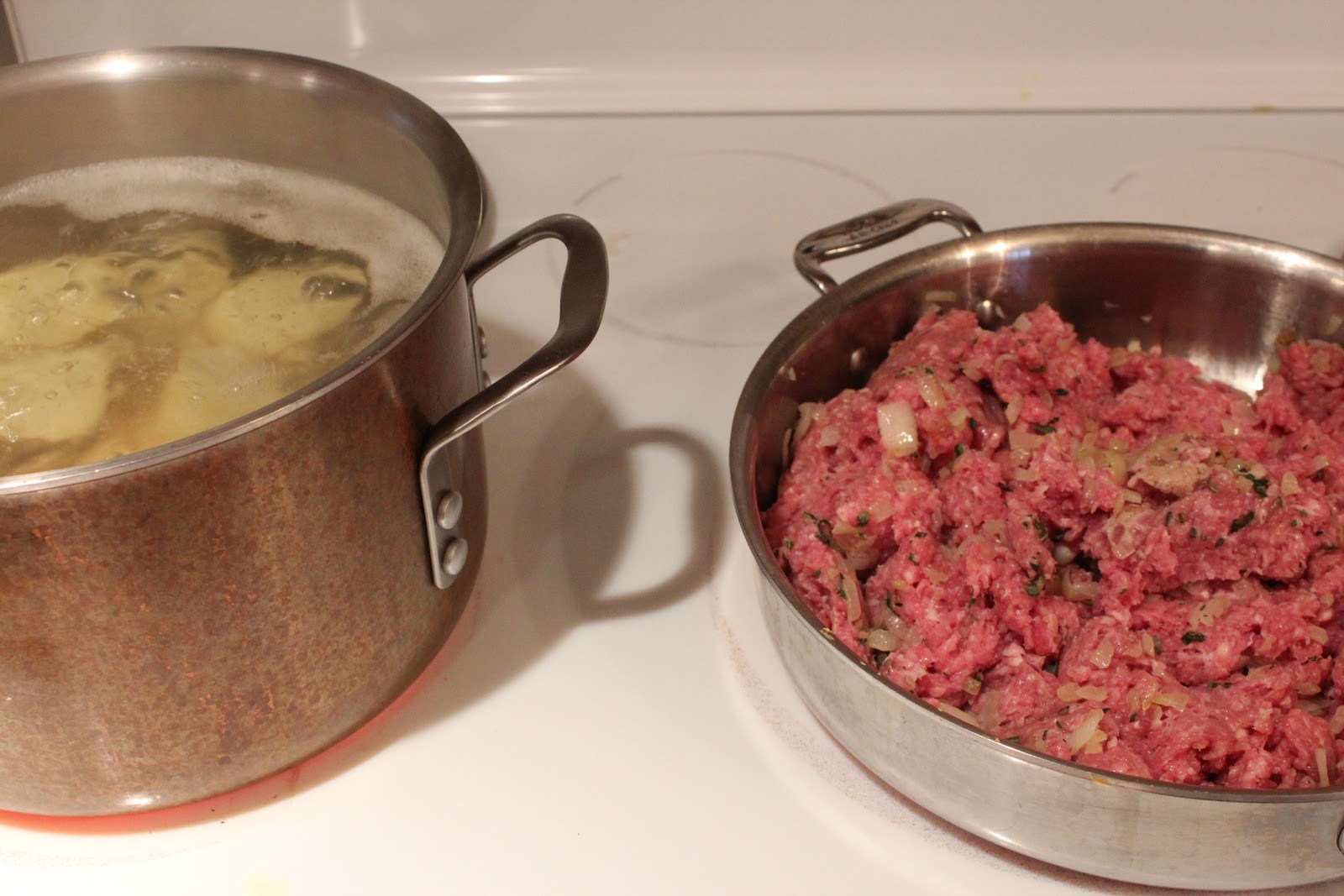
Start with boiling the potatoes. 

While potatoes boil, cook the meat filling. 


Meanwhile (in between checking and stirring the meat mixture):

Mince fresh herbs, about three to four sage leaves, thyme leaves from a sprig or two, and rosemary needles from a piece of branch. Each herb should equal about one-half teaspoon. 


Then grate fresh spices. Start with about one-quarter teaspoon of nutmeg and cinnamon each. After tasting, I added about another quarter teaspoon of cinnamon. In this meat pie, you should be able to taste a little cinnamon.


When the meat filling is done, add herbs and spices. 


The perfect time to start the crust, if it wasn't made in advance, is while potatoes and filling cool.

Flaky Pastry For One Two-Crust Pie
This recipe is for one meat pie. I wasn't sure how well it would double so I made two separate batches. It's similar to James Beard's recipe in his American Cookery cookbook so I don't think I'm giving away any great family secret!

2 cups sifted all-purpose flour
1 teaspoon salt
3/4 cup shortening, I used Spectrum Organic All Vegetable Shortening, non-hydrogenated
4 to 5 teaspoons ice water

Sift flour and salt together into a medium bowl, cut in shortening with a fork or two knives until it resembles course cornmeal. Pour onto a cutting board and sprinkle with water, one tablespoon at time, tossing lightly with a fork, knives, or pasty cutter. Shape into two equal size balls. Use immediately or cover and refrigerate until ready. If it's refrigerated, let it return to room temperature before rolling. Roll out onto floured surface.


Well, I'm not a baker and don't have much patience for it so let's just call it a rustic pie . . .


~  ~  ~

For more photos and more about the closing of this beautiful church that French-Canadian immigrants built, visit the American-French Genealogy website here.